Bunsen Burner Day (March 31)
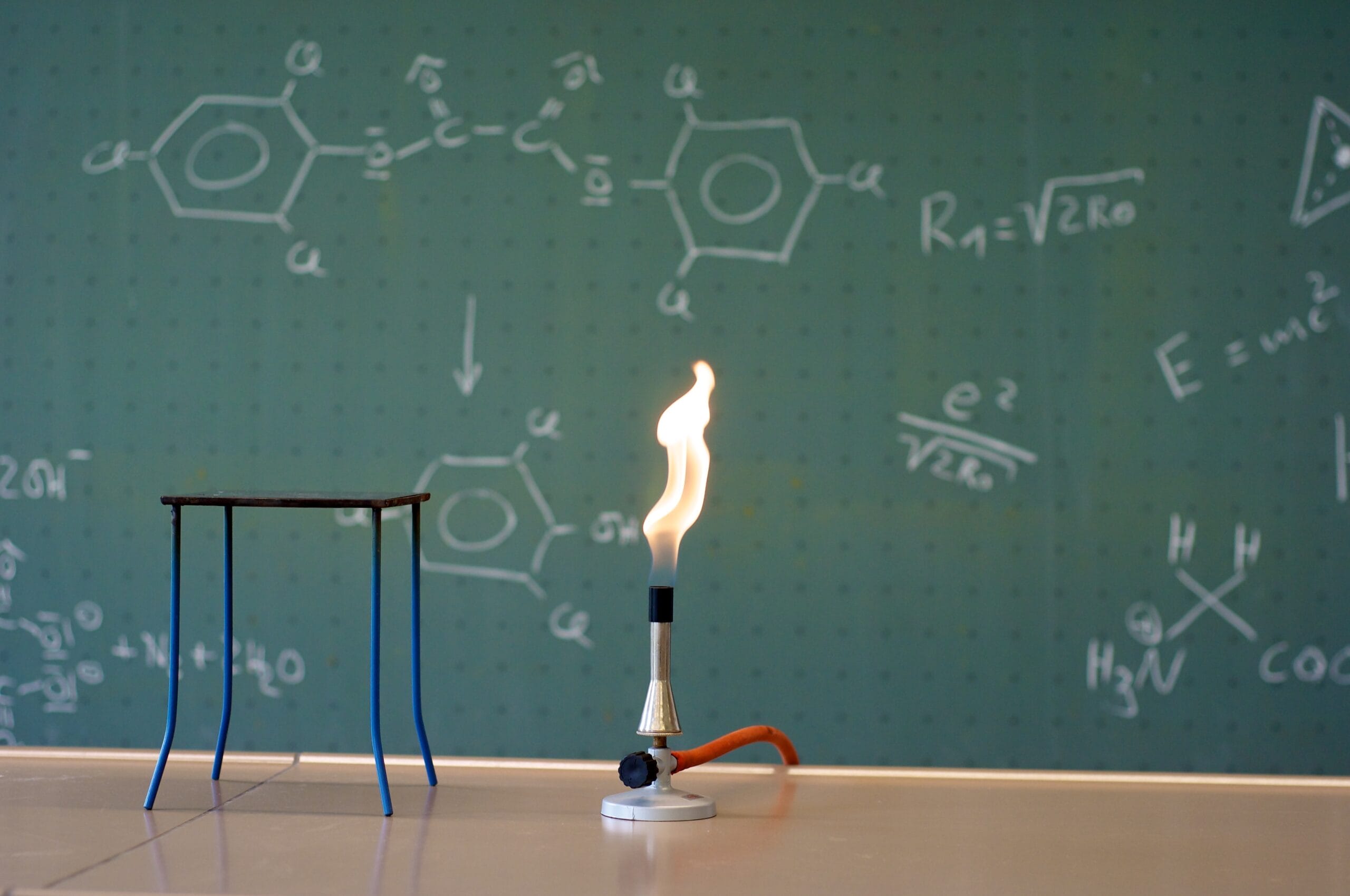
Bunsen Burner Day falls on March 31, and if you’ve ever stood in a lab waiting for that tiny blue flame to catch, you probably have stronger feelings about it than you expected.
It’s not glamorous equipment. It doesn’t get framed on classroom walls. But that steady, controlled flame quietly changed how science is done. For a lot of us, it was the first moment chemistry felt real, not just notes in a workbook, but heat, glassware, and a little responsibility.
It’s one of the more niche weird holidays in March, but for anyone who’s spent time in a lab, it feels oddly deserved.
When is the Holiday?
This holiday is celebrated annually on March 31st. This day honors the contributions of Robert Bunsen, the German chemist who invented the Bunsen burner, an essential tool in scientific laboratories worldwide.

Who Invented It?
Robert Wilhelm Eberhard Bunsen is credited with designing the burner that now carries his name. He was born on March 31, 1811, and spent much of his career improving laboratory methods.
What often gets skipped in quick summaries is that his lab assistant, Peter Desaga, built and refined the final working model in 1855. It was a collaboration, a scientist and a skilled instrument maker solving a practical problem.
And the problem was simple: lab flames were messy. They smoked. They fluctuated. They made precision difficult.
The redesigned burner mixed gas with air before ignition, producing that clean, adjustable blue flame we recognize from school labs.

The History of the Holiday
The holiday itself doesn’t have a dramatic origin story. It’s more of a quiet nod to a tool that made chemistry more precise.
Before this design, heating substances was inconsistent. With a controllable flame, chemists could:
- Reach higher temperatures
- Reduce soot contamination
- Repeat experiments more reliably
That reliability led to bigger breakthroughs.
Using their improved burner, Bunsen and Gustav Kirchhoff developed spectroscopy, identifying elements by the colors they emit when heated.
Through that work, they discovered Cesium and Rubidium.
A small flame. Two new elements. That’s not a bad legacy.

Top Facts About the Holiday
Bunsen never patented the burner. He believed scientific tools should be widely available.
The blue flame works because of complete combustion, more oxygen, cleaner burn.
That first time adjusting the air vent and watching the yellow flame turn blue? Still satisfying.
They’re still used today in microbiology labs and some metalwork settings.
And for many students, lighting one (under supervision) is the moment science stops feeling abstract.
Coloring Page
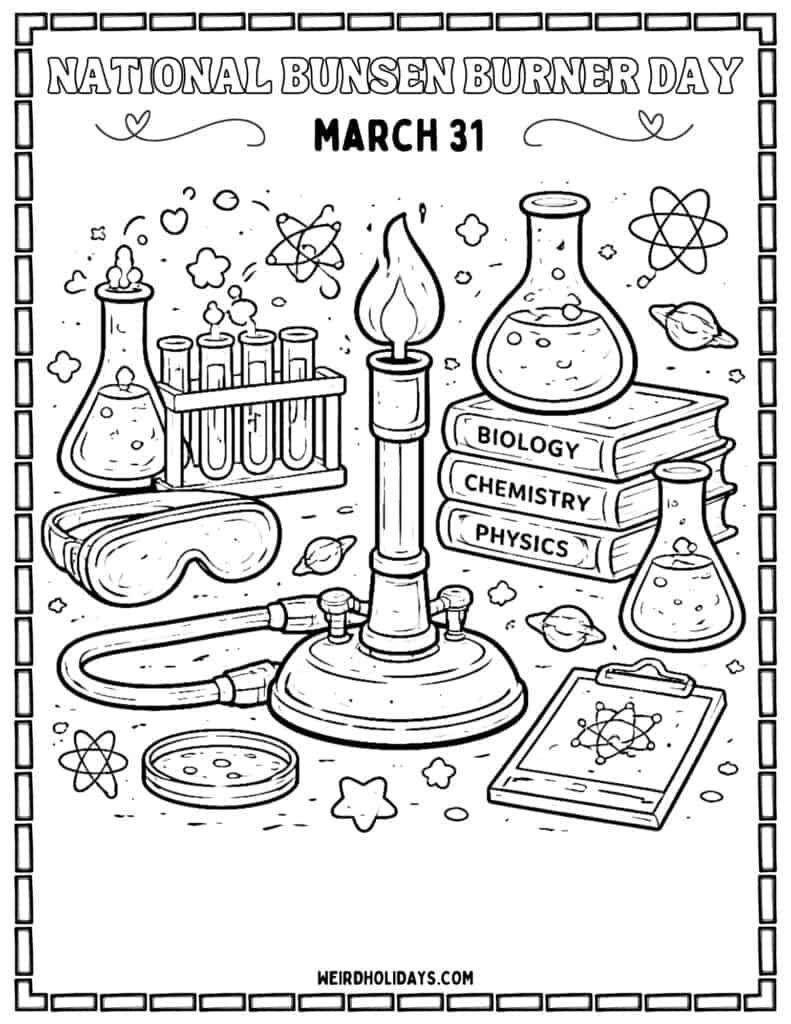
If you’re marking the day with younger students, a simple Bunsen burner coloring sheet keeps it approachable. It pairs well with a short explanation of why the flame changes color, easy win, low prep.
Activities to Celebrate
If you’re in a classroom with lab access, revisit the basics. Even demonstrating the difference between a yellow safety flame and a blue working flame opens the door to a quick conversation about oxygen, combustion, and lab safety.
With older students, it’s worth zooming out. The burner isn’t just equipment, it connects to spectroscopy, astronomy, and how we identify elements in distant stars.
No physical lab? Virtual flame tests still work well. Watching sodium burn bright yellow or copper glow green tends to stick in students’ memories longer than a paragraph in a textbook.
You could also turn it into a short discussion about how many scientific breakthroughs depend not on flashy discoveries, but on better tools.
Because that’s really what this day highlights: progress often starts with improving the basics.

**This post may contain affiliate links. As an Amazon Associate and a participant in other affiliate programs, I earn a commission on qualifying purchases.**
Useful Classroom Resources
If you’re actually working with burners, proper lab safety goggles are non-negotiable.
An introductory chemistry text that explains combustion and flame tests can help tie the equipment back to theory.
And for hands-on labs, a durable, adjustable burner makes a noticeable difference in consistency.

Related Holidays
- National Static Electricity Day (January 9) – A playful way to revisit simple physics experiments like balloon charges and sparks.
- National Battery Day (February 18) – Honors Alessandro Volta and the invention that made portable electricity possible.
- Pi Day – Celebrated on 3/14, this math holiday focuses on π, often with geometry activities (and plenty of pie).
- Pi Approximation Day – Observed on 22/7, another way to recognize the famous mathematical constant during the summer.
Pin it!
Share this post about National Bunsen Burner Day on Pinterest!
