National Sing Out Day (May 25)

May 25th makes a case that most people don’t need much convincing to accept. Singing feels good. Not performing, not perfecting, just singing.
National Sing Out Day is built around that simple premise and it’s deliberately inclusive about it. You don’t need to be good. You don’t need an audience. You just need to open your mouth and make some noise, which is an unusually low bar for a holiday and probably why it works.
When is the Holiday?
Every year on May 25th.
Who Invented It?
No official founder on record. It grew from the music education community and spread through schools, choirs, and social media as an informal celebration of vocal music that didn’t require any particular skill level to participate in.

The History of the Holiday
Singing is one of the oldest forms of human expression and one of the few that requires no equipment, no training, and no budget. Every culture across history has used vocal music for ritual, celebration, mourning, and community bonding. The specific holiday doesn’t have a founding moment but it sits within a long tradition of music educators and community leaders pushing back against the idea that singing is only for people who are good at it.
The research on this is actually worth knowing. Group singing in particular has been studied for its effect on social bonding, with choirs showing measurable increases in oxytocin and a sense of connection among participants. The benefits show up even in people who consider themselves bad singers, which is the whole point of a day like this.

Top 5 Facts About the Holiday
1. Singing reduces cortisol and releases endorphins. The mood-lifting effect is measurable and consistent across studies. It works whether you’re singing alone in the car or with a group, though the group effect tends to be stronger.
2. Being off-key doesn’t cancel out the benefits. Studies confirm that the physiological and psychological benefits of singing apply regardless of how it sounds. This is genuinely good news for most people.
3. Group singing increases social bonding. Particularly in choir settings, participants report a stronger sense of connection to others after singing together than after other shared activities. The synchronization of breath and voice appears to be part of what drives it.
4. Singing improves lung function. It works the respiratory muscles in a way that’s comparable to light cardio. Particularly beneficial for older adults and people with respiratory conditions who might not otherwise engage in physical activity.
5. It’s widely used in classrooms for a reason. Music literacy built through singing supports reading development, pattern recognition, and memory. Teachers who use singing as a regular classroom tool tend to see benefits that extend well beyond music lessons.

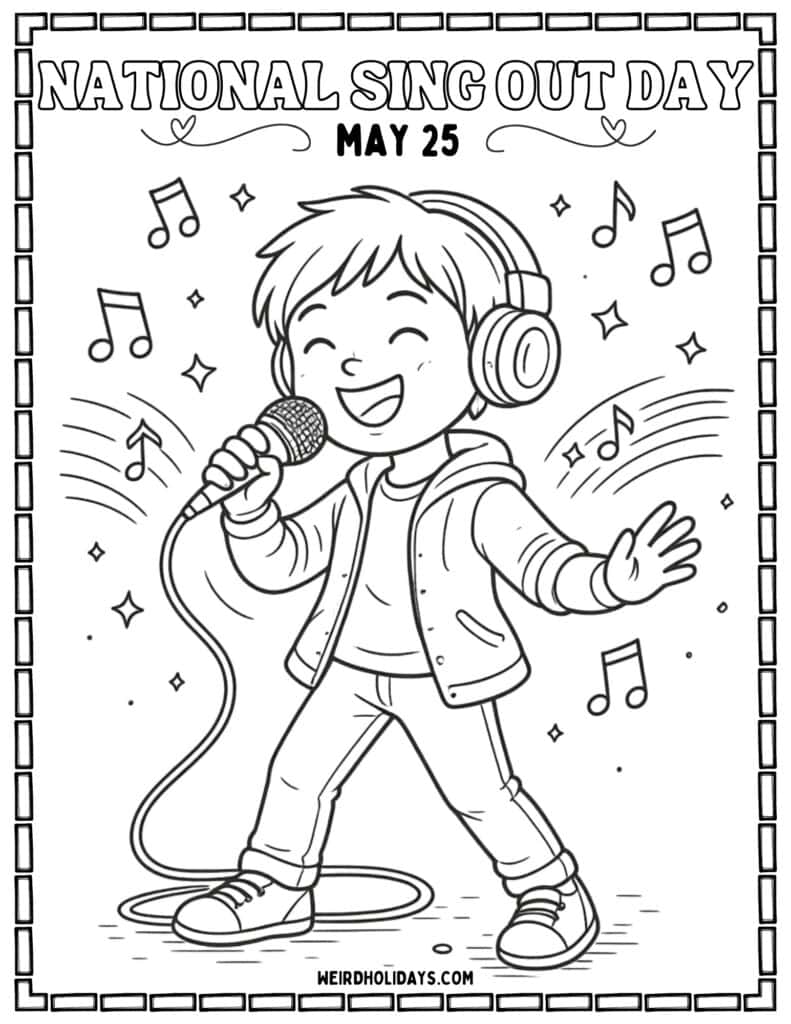
Coloring Page
Encourage younger kids to enjoy the day with this free coloring sheet.
Activities to Celebrate
A community sing-along is the most fitting version of this day and it requires less organization than it sounds. A playlist, a lyrics sheet, and a willing group of people is enough. Pick a theme that suits the crowd, Disney songs for a family gathering, classic pop for a mixed group, folk songs if you want something with more communal history behind it, and let it run.
Karaoke is the obvious solo or small group option. Set up a machine or use YouTube karaoke tracks, keep it casual, and lean into the silliness rather than the performance. Silly prizes for most dramatic delivery or best unexpected song choice keep the energy right.
For something more structured, a vocal warm-up workshop is worth running if you have kids or a group of people who are nervous about singing in front of others. Basic breathing exercises and simple warm-ups take about fifteen minutes and tend to lower the self-consciousness enough that people actually participate rather than watching from the edges.
An open mic visit is worth considering if there’s one nearby. Supporting local performers on a day dedicated to singing is a good fit, and the option to get up and sing something yourself is there if the mood strikes.
Links to Resources
Shure Vocal Microphone – a quality mic with USB and XLR outputs. Good for home vocalists who want to record properly or improve clarity during practice sessions.
Singing for Kids – sheet music and online tracks structured for younger learners. A good resource for parents and music educators running an activity around the day.
All-In-One Karaoke Machine – portable, Bluetooth enabled, wireless mic included. The right setup for a living room or backyard sing-along without needing any technical knowledge.
Composer Worksheets – printable packs covering famous composers’ lives and works. A good pairing for older children who want more context around music history.
Music Note Coloring Pages – basic music literacy through coloring activities. Low prep and works well for younger children alongside a singing session.
Paper Microphone Craft – a cut and color activity for preschoolers who want to perform on their own terms. Simple, effective, and requires no supplies beyond paper and crayons.

Related Holidays
World Radio Day (February 13) – a reminder of how far a voice can travel and how music connects people across distances that would otherwise keep them separate.
Uncommon Musical Instrument Day (July 31) – expands the musical picture beyond vocals to the stranger and more unexpected end of the instrument world. A good follow-on for anyone whose interest in music gets sparked today.
National Buy a Musical Instrument Day (May 22) – lands three days before this one and makes a natural lead-in. An instrument to accompany the vocals makes today feel like the logical next step.
Pin it!
Share this post about National Sing Out Day on Pinterest!
