Create a Vacuum Day (February 4)
Create a Vacuum Day on February 4 is one of those holidays that makes you stop and think… wait, what?
It’s a fun excuse to explore the science behind vacuums, from everyday household tools to the vast emptiness of outer space.
Whether you’re into hands-on experiments or just curious about how things work, this quirky February holiday has something to discover.
When is the Holiday?
It’s observed every year on February 4th.
Who Invented It?
The exact origin of the holiday isn’t known, but the theme comes from centuries of scientific curiosity about empty space and air pressure.
The History of the Holiday
People have been curious about vacuums since ancient times, when philosophers debated whether true emptiness could exist. In 460 B.C., Democritus suggested there was empty space between atoms, while Aristotle famously argued that “nature abhors a vacuum.” This disagreement sparked centuries of scientific debate.
By the 17th century, scientists began proving vacuums were possible. Galileo Galilei and his student Evangelista Torricelli experimented with mercury-filled tubes to study air pressure. Torricelli’s work eventually led to the invention of the barometer. Around the same time, Blaise Pascal continued exploring how air pressure and vacuums worked.
These discoveries shaped modern science and everyday technology. In the late 1800s, Thomas Edison used vacuum technology in incandescent light bulbs, helping pave the way for modern electrical devices.
From outer space to household vacuum cleaners, the day highlights how humans continue to explore and understand the world around them.

Top 5 Facts About Create a Vacuum Day
- The word vacuum comes from the Latin vacuus, meaning empty or void.
- While outer space comes close to a perfect vacuum, it’s impossible to create one on Earth.
- Early vacuum experiments in the 1600s helped scientists understand air pressure.
- Everyday items like vacuum cleaners, syringes, and car brakes rely on vacuum technology.
- Vacuum-sealed packaging removes air to help keep food fresh longer.
Coloring Page
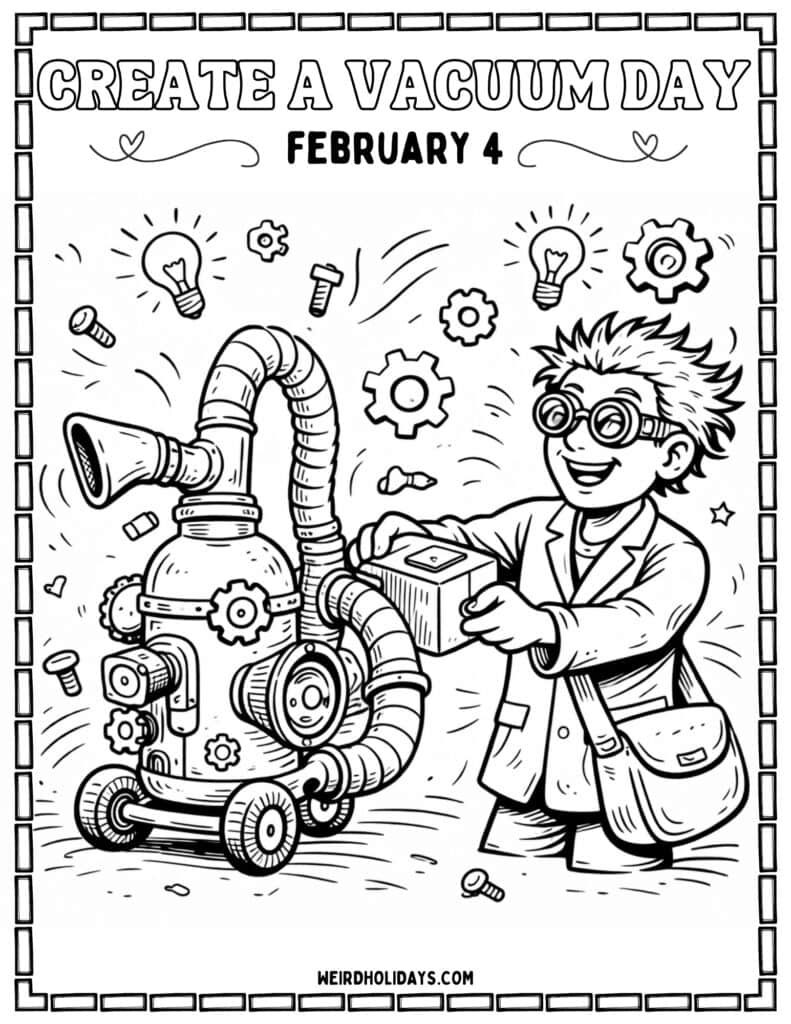
If you’re celebrating with kids, this free Create a Vacuum Day coloring page is a fun way to connect science and creativity.
**This post may contain affiliate links. As an Amazon Associate and a participant in other affiliate programs, I earn a commission on qualifying purchases.**
Activities to Celebrate
- Turn chores into a game by timing a family vacuuming challenge.
- Try simple science experiments using straws and water to explore air pressure.
- Learn about Galileo and early vacuum experiments with kid-friendly videos or books.
- Watch a short documentary about outer space and how vacuums work in space.
- If you’re due for an upgrade, research modern vacuum cleaners and compare features.
Links to More Resources
- What happens to your body in the vacuum of space (SciShow) – A kid-friendly video explaining how space affects the human body.
- Steve Spangler’s air pressure experiments – Fun, hands-on science activities that explore how air and vacuums work.
- Vacuum cleaner attachment guide – Learn what different attachments are for and how to use them properly.
- Good Night, Vacuum – A playful picture book that introduces young kids to everyday household tools.
- The Vacuum Cleaner History Book – A deeper look at how vacuums were invented and how they’ve changed over time.
Related Holidays
- National Clean Off Your Desk Day (January 10) – Focuses on tidying your physical workspace.
- National Clean Out Your Computer Day (Second Monday in February) – Declutter your digital space.
- National Battery Day (February 18) – Celebrates everyday tech that powers devices.
Pin it!
Share this post about making vacuums on Pinterest!