National Everything You Think is Wrong Day (March 15)

March 15 is National Everything You Think Is Wrong Day, which sounds confrontational.
It isn’t.
It’s more of a pause button.
The idea isn’t to prove anyone wrong. It’s to consider the possibility that you might be. Which, if we’re honest, is occasionally true.
When Is the Holiday?
This weird holiday is observed annually on March 15th. Easy to remember, especially since it shares the date with the Ides of March. Dramatic history. Slightly dramatic holiday name. It fits.
Who Invented It?
No official founder.
Which feels appropriate.
It likely started as a tongue-in-cheek idea that stuck, because it hits something universal. We all carry around beliefs we rarely stop to question.
And every so often, we’re completely certain… and completely wrong.

The History of the Holiday
There isn’t a tidy origin story for National Everything You Think Is Wrong Day.
Which, honestly, fits.
It appears to have emerged from the broader conversation around critical thinking — especially the idea that certainty isn’t the same thing as accuracy.
In the last couple of decades, psychologists have started studying something called “intellectual humility,” the ability to admit you might be wrong. Research shows people who score higher in it tend to evaluate evidence more carefully and change their views more rationally.
A holiday built around that idea makes sense.
It’s less about winning arguments and more about testing assumptions.
Fun (and Real) Facts About Being Wrong
Most people believe they’re less biased than the average person. It’s called the “bias blind spot.” Ironically, that belief itself is a bias.
The more confident someone feels about a memory, the more likely it is to be distorted. Confidence and accuracy aren’t the same thing.
Studies show that when people are presented with evidence that contradicts their beliefs, they often double down instead of reconsidering. It’s known as the “backfire effect.”
People are more willing to change their minds when they feel respected rather than attacked.
In experiments, asking “What evidence would change your mind?” leads to more thoughtful answers than asking “Why are you right?”
**This post may contain affiliate links. As an Amazon Associate and a participant in other affiliate programs, I earn a commission on qualifying purchases.**
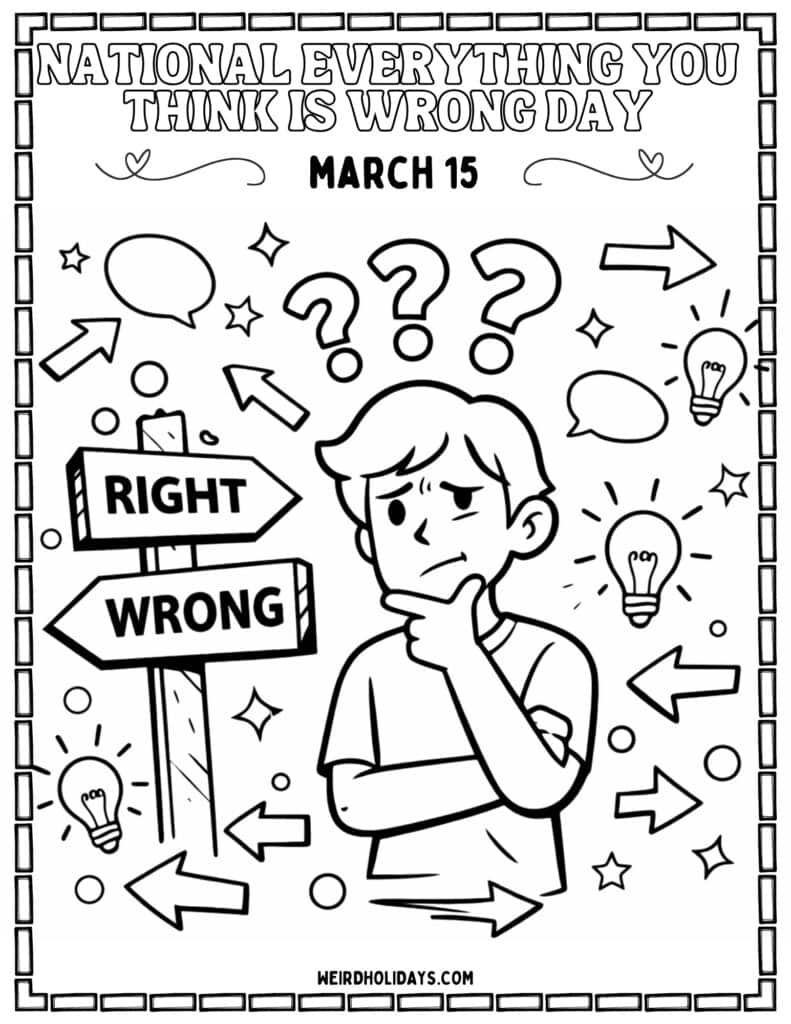
Coloring Page
If you want something lighter to start the conversation, there’s a printable coloring page below. It keeps the tone playful while still nudging the idea that maybe, just maybe, we don’t know everything.
Activities to Celebrate
If you’re feeling brave, try debating the opposite of what you actually believe. Not to win. Just to see how solid your reasoning really is. It’s uncomfortable. That’s the point.
You could also pick a “fact” you’ve repeated for years and actually check it. Where did it come from? Is it still accurate? A surprising number of common sayings fall apart under basic research.
For a quieter version of the day, read something that challenges how people think. Thinking, Fast and Slow is a good place to start if you’re curious why your brain jumps to conclusions so quickly.
Another simple exercise: take one strong opinion you hold and ask yourself what evidence would change your mind. If the answer is “nothing,” that’s interesting.
And if you want to keep it social, host a trivia night built around trick questions and common misconceptions. The goal isn’t to embarrass anyone. It’s to create those small “wait… really?” moments that remind us certainty isn’t the same thing as accuracy.

Related Recipes for the Holiday
If the whole point of today is challenging what you “know,” the kitchen is a pretty fun place to start. Food has a way of surprising people, especially when it doesn’t look or sound like what you expect.
Take buttercream succulent cupcakes. At first glance, they look like tiny potted plants you’d find on a windowsill, but they’re completely edible and unapologetically sweet. They’re always good for a double take.
Chickpea cookie dough balls are another one that tends to raise eyebrows. Most of us grew up being told not to eat raw dough, but this version skips the usual ingredients and is safe to enjoy straight from the bowl. It’s one of those recipes that sounds questionable until you try it.
A vegan sushi cake is exactly what it sounds like, layers shaped like a cake, but made entirely from sushi ingredients. It looks celebratory, slices like dessert, and then completely flips expectations once you taste it.
Healthy black bean fudge might be the biggest skeptic-converter on the list. The ingredient list doesn’t scream “dessert,” but the end result is rich and chocolatey enough to surprise even the most doubtful taste tester.
And if you want something simple and visual, try dyeing potatoes the way you’d normally dye eggs. It’s unexpected, slightly odd, and oddly satisfying, which feels perfectly on theme for a day dedicated to rethinking what we assume is true.

Links to Resources
If you want to lean into the thinking side of this day, a few books actually make it easier to practice instead of just talk about it.
- The Thinking Toolbox is one of those books that doesn’t feel flashy, but it’s useful. The lessons are short. Direct. You can do one and stop without feeling like you signed up for a semester-long course in logic.
- Logic Workbook for Gritty Kids is lighter. It’s more puzzle-driven, which helps if you have a kid who shuts down the second something feels like “critical thinking.” It sneaks the skills in.
- Great Debates for Kids is exactly what it sounds like. Structured arguments. Clear sides. It works well if you want to practice disagreeing without it turning into chaos. Which, realistically, is half the battle.

Related Holidays
If you enjoy the playful, perspective-shifting nature of this day, there are a few other observances that lean into the same spirit of fun and unpredictability.
- National Opposite Day (January 25) is all about flipping things around, saying the opposite of what you mean or reversing routines just for fun. It’s silly, but it highlights how automatic our thinking can be.
- National Ice Cream for Breakfast Day (First Saturday in February) breaks the “rules” of mealtime by putting dessert first. It’s lighthearted and a good reminder that traditions aren’t set in stone.
- Pi Day (March 14) celebrates the number 3.14 with math activities and plenty of pie puns, blending logic with a bit of humor.
Pin it!
Share this post about National Everything You Think is Wrong Day on Pinterest!