
National Scavenger Hunt Day (May 24)
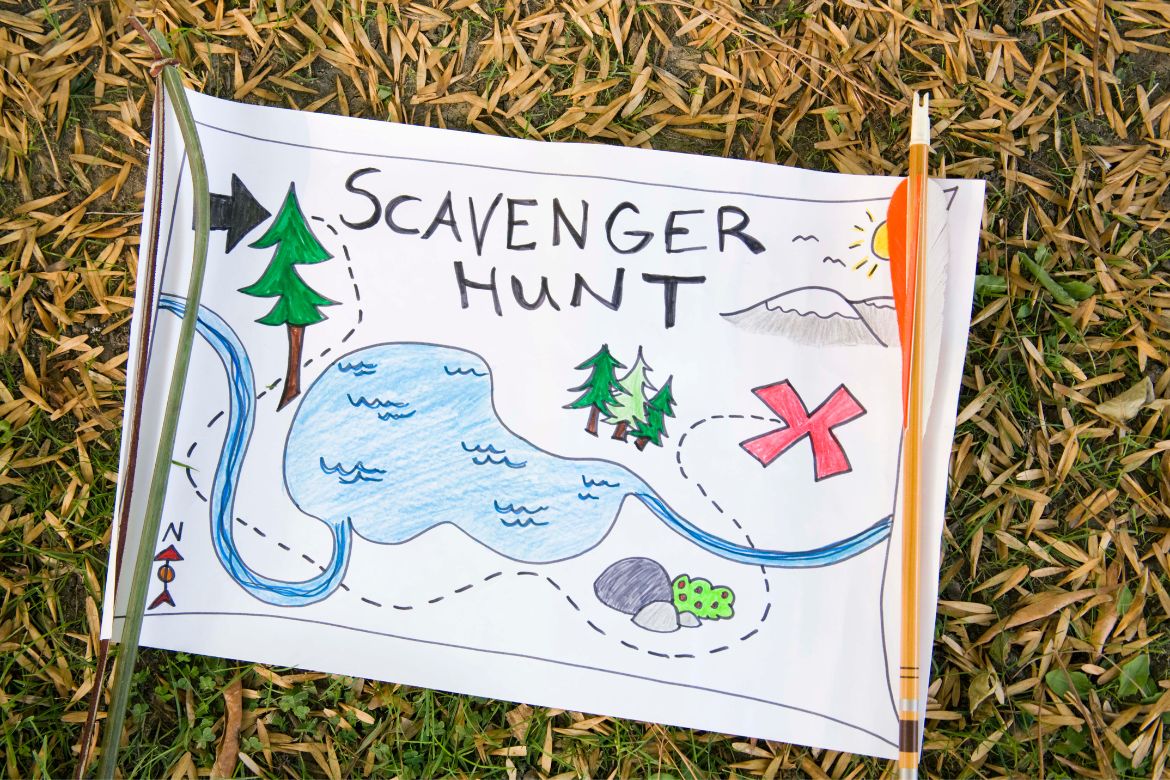
May 24th is one of those holidays that works for almost any age, any setting, and any amount of preparation time. National Scavenger Hunt Day has a low barrier to entry. A list, some hidden objects, and a reason to look around more carefully than usual.
That’s the whole structure, and it’s been enough to make the scavenger hunt a staple of parties, classrooms, team-building days, and family afternoons for the better part of a century.
When is the Holiday?
Every year on May 24th.
Who Invented It?
No official founder for the holiday itself, but the modern scavenger hunt has a clear origin point. Elsa Maxwell, a socialite and party planner with a talent for spectacle, hosted one of the first organized scavenger hunts for her elite social circle in 1932.
Her version involved genuinely absurd tasks, including tracking down a bald man’s signature, which tells you something about the crowd she was entertaining. The format caught on quickly and spread well beyond its original context.

The History of the Holiday
The word scavenger originally referred to street cleaners in medieval England, people whose job was to collect and sort through what others had discarded. The connection to the modern game is loose but the searching-and-collecting logic carries through.
Elsa Maxwell‘s 1930s events brought the format into mainstream culture and from there it moved into schools, corporate events, and eventually digital spaces. Geocaching, which is essentially a GPS-based global scavenger hunt, now has over three million active caches hidden worldwide.
The Amazing Race and National Treasure both borrowed the same basic structure and brought it to film and television audiences who may not have connected those plots back to Elsa Maxwell’s Manhattan dinner parties, but the lineage is there.

Top 5 Facts About the Holiday
1. Elsa Maxwell’s hunts included genuinely strange tasks. Finding a bald man’s signature was one of them. The point was the absurdity as much as the search, which is still good design philosophy for a scavenger hunt.
2. Geocaching has over three million active caches worldwide. Hidden in cities, forests, and everywhere in between, logged and tracked through a global community. It’s the most scaled-up version of the scavenger hunt concept that exists.
3. The word scavenger has medieval roots. Originally used for street cleaners whose job involved collecting discarded materials. The searching logic translated into game format over several centuries.
4. Scavenger hunts are used in classrooms to teach across subjects. Math, reading comprehension, science, history. The format is flexible enough to carry almost any educational content and the engagement level tends to be higher than a worksheet on the same material.
5. The Amazing Race has been running since 2001. It’s one of the longest-running reality competition formats on television and it’s essentially a scavenger hunt at global scale. The format clearly has more longevity than anyone expected when it launched.

Coloring Page
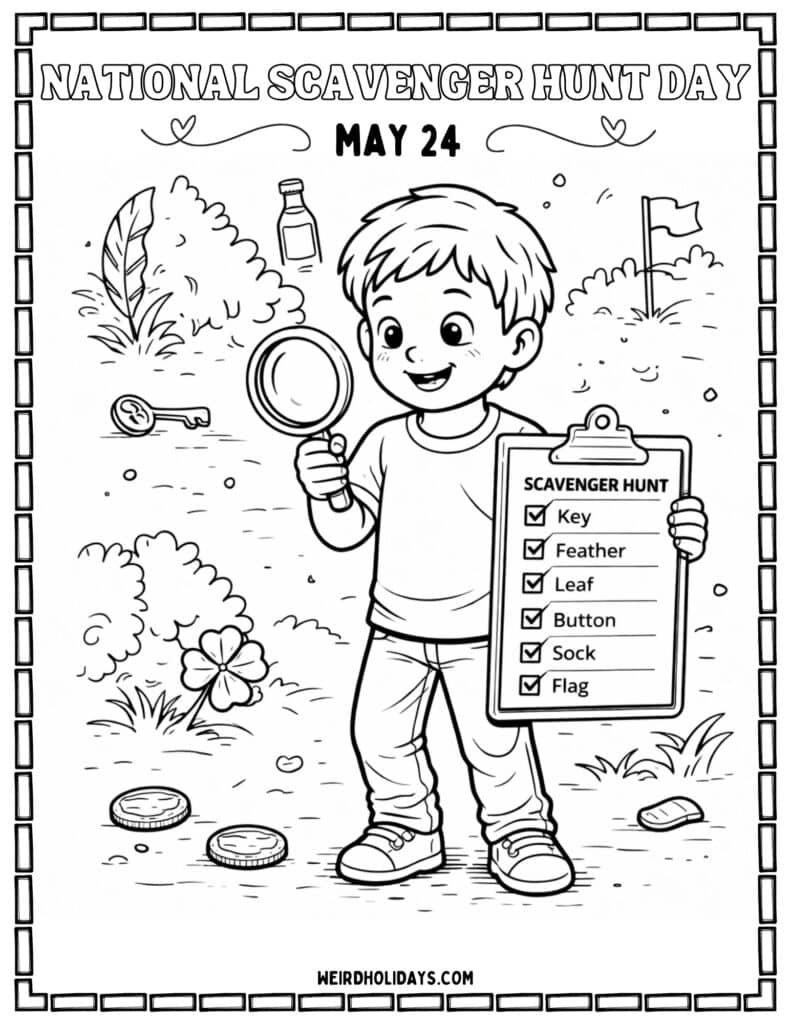
Print the scavenger hunt coloring sheet for younger kids to use before or after the main activity. It works well as a quiet wind-down after an active hunt or as something to do while older siblings tackle a more complex version.
Activities to Celebrate
The simplest version is a backyard or indoor hunt with a handwritten list. Find something red, something with a funny texture, something older than you are. It takes ten minutes to set up and runs itself from there. For younger kids, visual lists with pictures work better than written ones and keep the activity accessible without adult help at every step.
A nature hunt is a good option for late May specifically. Feathers, pinecones, specific leaf shapes, insects, anything seasonal and findable without going far. A clipboard and a printed checklist gives it enough structure to feel like a proper activity rather than just wandering around.
For older kids and teenagers, a photo hunt adds a layer of creativity. Give them a list of scenes or objects to photograph rather than collect. The interpretation element means every result is different and the debrief afterward is usually more interesting than a standard hunt.
If you want something more involved, a puzzle-based escape room version is worth the setup time. Chain the clues together so each answer leads to the next location, and build in a problem to solve at each stop. It takes more planning but works well for a group and the difficulty can be scaled in either direction.
The printable hunts in the resources section cover most settings and themes so there’s no need to build everything from scratch if time is short.

Links to Resources
Here are a few popular free scavenger hunt printables:
Zoo scavenger hunt – kids look for specific animals, behaviors, and habitats as they move through the zoo. A good way to give a zoo trip some extra structure.
Neighborhood scavenger hunt – uses chalk markings, street signs, and yard objects. Easy to set up, good for after school or weekend afternoons.
Beach scavenger hunt – shells, sandcastles, beach creatures. A natural fit for summer trips and requires no preparation beyond printing.
Summer scavenger hunt – a general warm-weather version with seasonal prompts. Works for park days or backyard play throughout the season.
Book scavenger hunt – turns reading into a search activity. Kids hunt for character names, genres, plot elements. A good way to make independent reading more interactive.
Lego themed scavenger hunt clues – riddles with building challenges built in. Good for an indoor day with younger kids who are already into Lego.
Star Wars scavenger hunt clues – themed around characters, quotes, and settings. A natural pairing with Talk Like Yoda Day earlier in the month.

Related Holidays
National Video Game Day (July 8) – many games are built around quest and collection mechanics that operate on exactly the same principles as a scavenger hunt. A good follow-on for kids who enjoyed today.
Sherlock Holmes Day (May 22) – lands just two days before this one. A clue-based hunt is a natural extension of a day spent thinking about detective logic and observation.
National Puzzle Day (January 29) – covers the mental side of what makes scavenger hunts satisfying. Logic, deduction, the pleasure of a problem that has a solution.
Pin it!
Share this post about National Scavenger Hunt Day on Pinterest!
