
International Day of Families (May 15)

May 15th is home to one of the UN’s most meaningful observances of the year. International Day of Families was established in 1993 and it covers a lot of ground.
It’s not just about the nuclear family or any one version of what family looks like. It’s about recognizing that families, in all their forms, are where most of us learn how to exist in the world.
Every structure counts here, every setup, every combination of people who show up for each other.
When is the Holiday?
Every year on May 15th.
Who Invented It?
The United Nations officially declared it in 1993. The thinking behind it was straightforward: families are the foundation of social life, and the challenges families face deserve dedicated global attention. It came out of a broader shift in the 1980s when changing demographics and social structures made family-centered policy a more pressing conversation.

History of the Holiday
The UN began focusing on family issues in the 1980s as it became clear that urbanization, shifting economies, and changing social norms were putting pressure on family structures in different ways across different countries.
Resolution A/RES/47/237 formally established the day, and it picked up further momentum at the 1995 World Summit for Social Development.
Each year the UN assigns a theme that reflects a current issue, whether that’s poverty, digital technology, work-life balance, or climate change. The themes are worth looking up because they’re often more specific and interesting than you’d expect.

Top 5 Facts About the Holiday
1. The day covers every kind of family. Grandparent-led households, foster families, single parent families, multigenerational setups, communal living arrangements. The UN’s definition is deliberately broad and that’s intentional.
2. One year the theme was climate change. The connection being that household habits and family decisions collectively have significant environmental impact. It’s a reminder that the personal and the global aren’t as separate as they sometimes feel.
3. In 2012, Brussels celebrated with chocolate coins stamped with EU family themes. Which is a genuinely good way to get people to pay attention to a UN observance.
4. Students in parts of Europe mark it with mock parliaments. They debate family-centered policy as members of the European Parliament. It’s one of the more creative ways a holiday gets observed anywhere on this calendar.
5. Past celebrations have included global photo movements. Families sharing images and stories online to build a visual record of what family looks like across different cultures and continents. The archive that came out of those campaigns is worth looking at.

**This post may contain affiliate links. As an Amazon Associate and a participant in other affiliate programs, I earn a commission on qualifying purchases.**
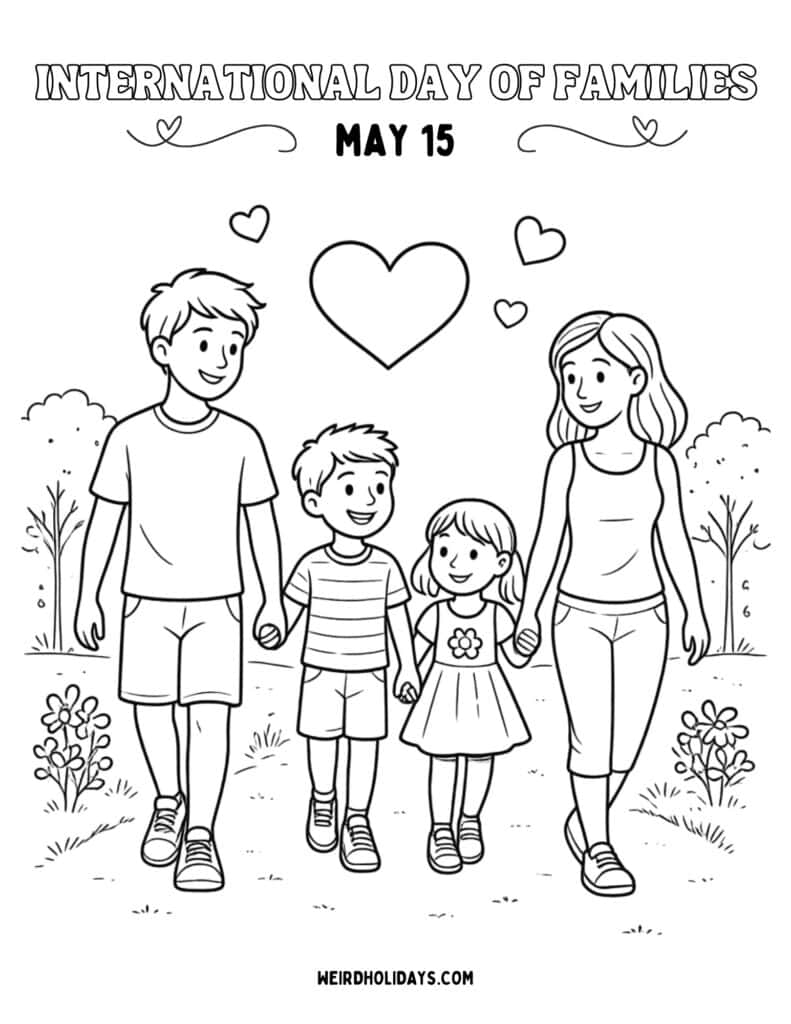
Coloring Page
A simple activity for younger kids while the family is together. Print it off and let them color while the adults are talking or cooking. It also works well as a classroom activity paired with a book about different family structures.
Activities to Celebrate
The most fitting thing you can do today is actually spend time together without an agenda. Put the screens away, cook or order something everyone likes, and let the evening be unstructured. That sounds simple but it happens less often than most families would like to admit.
If you want something more intentional, a family vision board works well as a shared activity. Sit down together and map out goals, things you want to do as a family, places you want to go, things you want to change. Kids take this seriously when adults treat it seriously, and it gives the day a lasting outcome rather than just a nice evening.
Reading together is another good option, especially with younger children. Books like All Kinds of Families reflect different family structures in an accessible way and open up conversations that are worth having. Pair it with the family tree worksheet from the resources below and you have a full afternoon activity.
Volunteering together is worth considering if you want to mark the day in a way that connects to its broader meaning. A local food bank, a neighborhood clean-up, or dropping off donations somewhere takes a couple of hours and tends to leave everyone feeling better than a passive celebration would.

Links to Resources
- UN’s Official Families Page – yearly themes, background reading, and official publications. Worth checking before the day to see what the current theme is.
- Family Discussion Guide Printable – conversation starters around values, roles, and goals. Good for a dinner table conversation or a classroom setting.
- Family Tree Worksheet – helps kids trace generational connections and understand where they come from. Works well at home or in school.
- Free Parenting Resources from UNICEF – practical tools for building stronger communication and relationships within families.
- Printable Family Goals Sheet – a collaborative activity for setting short and long term goals together. Good follow-on from a vision board session.
- Support Resources for Military Families – printables and practical tips for families navigating deployment, transition, or reintegration. A useful one to share if you know families who need it.

Related Holidays
Other celebrations that highlight relationships and care include:
National Siblings Day (April 10) – a more specific slice of the family picture. A good one to bookmark alongside this one.
Please Take My Children to Work Day (June 25th) – a tongue-in-cheek counterpoint to today’s sincerity. Acknowledges the less glossy side of family life in the most relatable way possible.
Pin it!
Share this post about International Day of Families on Pinterest!
