Tolkien Reading Day (March 25)
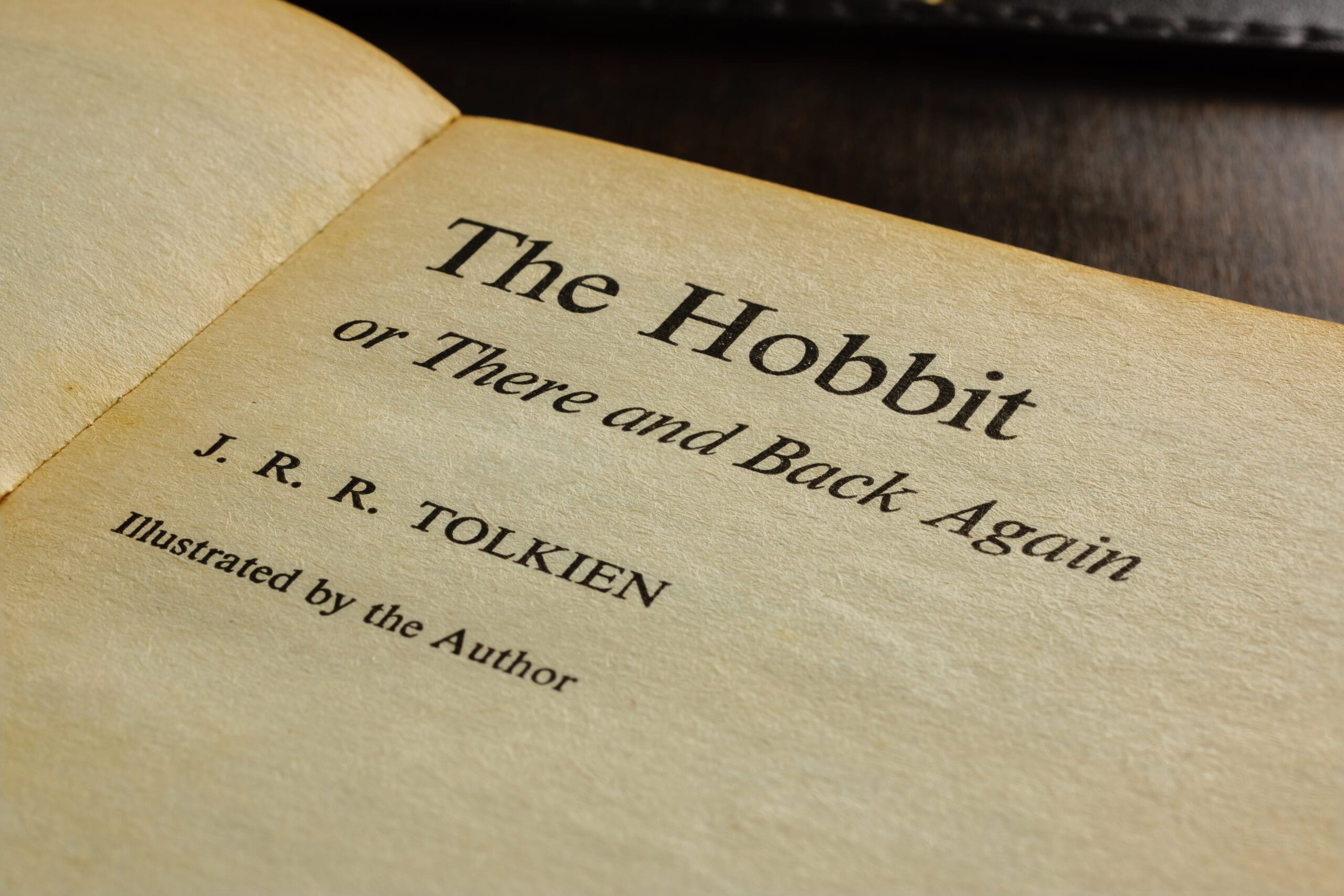
Tolkien Reading Day falls on March 25, and it’s one of those quiet literary holidays that people either deeply appreciate or have never heard of.
It isn’t commercial. There’s no themed merchandise push. It’s simply an invitation to sit down and read Tolkien.
For some people, that means revisiting a favorite passage from The Lord of the Rings. For others, it’s finally opening The Hobbit with a child and watching them meet hobbits for the first time.
It’s one of the more thoughtful weird holidays in March, the kind that feels less like an event and more like an excuse to slow down.
When is the Holiday?
Tolkien Reading Day is observed every year on March 25. The date isn’t random. Within The Lord of the Rings, March 25 marks the fall of Sauron and the destruction of the One Ring, the turning point where darkness lifts in the Third Age.
It’s rare for a literary holiday to be tied so precisely to an in-story moment.
Who Started It?
Tolkien Reading Day was launched in 2003 by the The Tolkien Society.
Instead of organizing a festival or convention, the idea was simple: read Tolkien on that day. Each year, the Society suggests a theme, things like “Travel and Adventure” or “Love and Friendship”, to guide readers.
It’s understated on purpose.
How It’s Grown
This didn’t begin as a social media trend. It came out of a community that was already studying, discussing, and rereading Tolkien’s work.
Over time, libraries, schools, and reading groups began using the annual themes to structure discussions or choose passages. Some approach it academically. Others treat it as a cozy family tradition.
What’s unusual about this day is that it bridges two very different audiences:
- readers who simply love the story
- scholars who study his languages, mythology, and structure
Not many literary observances manage to sit comfortably in both spaces.

Facts About the Holiday
- March 25 is the day in The Lord of the Rings, the One Ring is destroyed, and Sauron falls. Tolkien chose that date carefully in his fictional timeline, which makes it one of the few literary holidays tied directly to an in-story event.
- J. R. R. Tolkien didn’t start out as a novelist. He was a philologist at University of Oxford, fascinated by how languages evolved. In fact, he began inventing Elvish languages years before writing The Hobbit. The stories grew out of the languages, not the other way around.
- The holiday itself was introduced in 2003 by the Tolkien Society, and each year they suggest a theme to guide readers. Some years focus on friendship, others on journeys or courage. It keeps the day from feeling repetitive.
- Middle-earth was never meant to be a separate fantasy planet. Tolkien described it as a distant, mythic past of our own world. That’s why the landscapes feel so grounded, they’re rooted in Northern European geography and legend.
- Tolkien and his wife Edith share a grave in Oxford marked with the names “Beren” and “Lúthien,” two lovers from his legendarium. Their real-life relationship directly inspired one of the most important stories in The Silmarillion.
Coloring Page
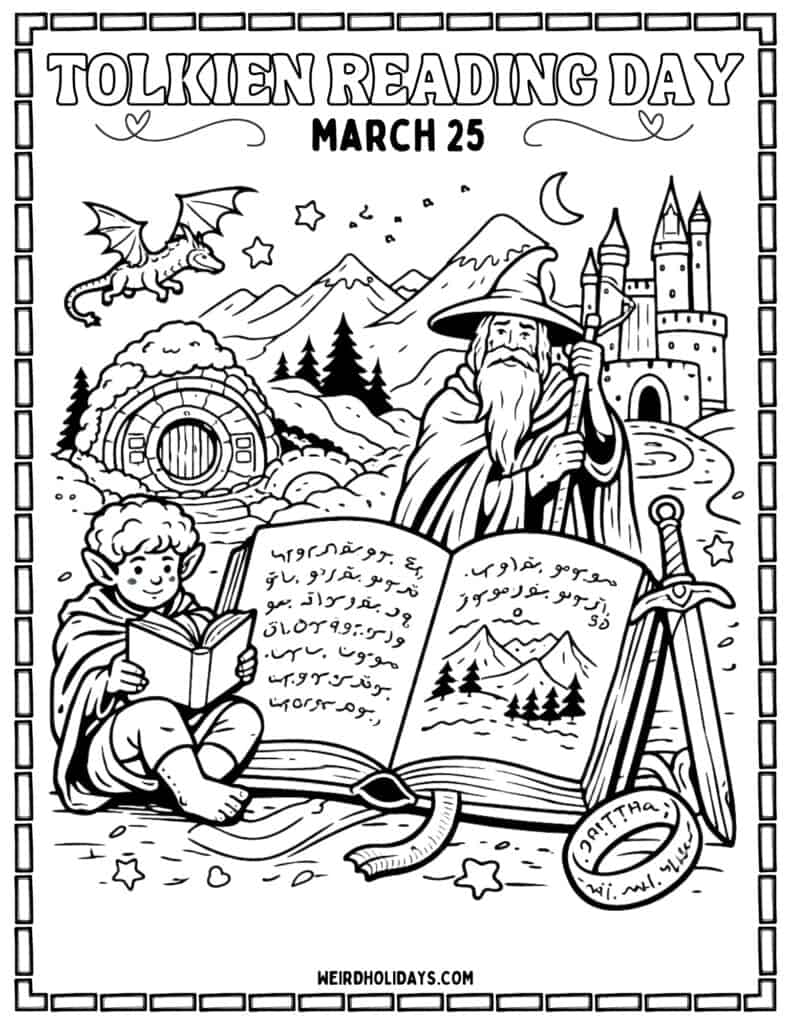
If you’re celebrating with kids or simply want a quiet activity to go along with your reading, this Tolkien Reading Day coloring page is an easy way to bring Middle-earth into the day.
**This post may contain affiliate links. As an Amazon Associate and a participant in other affiliate programs, I earn a commission on qualifying purchases.**
Activities to Celebrate
The simplest way to mark the day is to read something. It doesn’t have to be ambitious.
One chapter of The Hobbit after dinner counts. So does rereading a favorite scene. So does listening to an audiobook while you cook.
If you like structure, you can follow the Tolkien Society’s annual theme and choose a passage that fits. It adds a bit of intention without turning it into a school assignment.
Comparing a book scene with its film adaptation can also spark surprisingly thoughtful conversations, especially about what gets cut or changed and why.
For something more hands-on, writing your name in Tengwar using an online chart is a small but memorable activity. Kids tend to love seeing their name transformed into Elvish script.
Or lean into the atmosphere. Bake simple shortbread and jokingly call it lembas. Sketch maps. Spend an hour rereading in a quiet corner.
The point isn’t productivity. It’s immersion.

Links to Resources
If you want to go a little deeper than just rereading The Hobbit, here are a few places that are actually worth your time.
The Tolkien Society posts the annual theme for Tolkien Reading Day each year, along with prompts and ideas. It’s interesting to see how other readers approach it — some go scholarly, some keep it cozy.
Wheaton College houses one of the largest Tolkien archives in North America. If you’re even mildly curious about drafts, letters, or how his ideas evolved, their collection is fascinating to browse. It makes Middle-earth feel less mythical and more handwritten.
If you’ve ever wondered why Tolkien’s world feels so layered, The Road to Middle-earth by Tom Shippey explains it without being intimidating. He breaks down how Tolkien’s background in language and medieval texts shaped the stories in ways most of us don’t consciously notice.
For something slightly more niche, A Question of Time by Verlyn Flieger looks at how Tolkien handles time, especially in The Silmarillion. It’s one of those topics you didn’t realize was unusual until someone points it out.
If you’re introducing Tolkien to younger readers, Who Was J.R.R. Tolkien? is a good starting point. It gives the basics of his life without overwhelming them before they even meet a hobbit.
And if you’re more interested in the bigger picture, how Tolkien’s work keeps resurfacing in films, games, and modern fantasy, Why We Love Middle-earth looks at that lasting influence.

Related Holidays
If Tolkien Reading Day puts you in a bookish mood, there are a few other dates that celebrate storytelling in different ways.
- Free Comic Book Day (First Saturday in May) – A celebration of graphic storytelling, world-building, and fandom culture. Local comic shops usually offer free special editions, and it’s a surprisingly good way to explore fantasy in a completely different format.
- Sherlock Holmes Day (May 22) – Honors another iconic British literary figure. It’s a nice excuse to trade epic quests for sharp deduction and revisit classic detective fiction.
- National Book Lovers Day (August 9) – No theme. No structure. Just an open invitation to read whatever’s been sitting on your shelf waiting for attention.
- National Read a Book Day (September 6) – A gentle reminder to unplug and spend a few uninterrupted hours with a physical book, whether that’s Middle-earth or something completely different.
Pin it!
Share this post about Tolkien Reading Day on Pinterest!
