
National Pack Rat Day (May 17)

May 17th is the one day a year where the drawer full of random cables, the stack of magazines you’re definitely going to read, and the box of concert tickets from 2009 all get to exist without judgment.
National Pack Rat Day doesn’t shame you for keeping things. It leans into the very human habit of holding on, acknowledges that most of us do it to some degree, and invites a little reflection on why that stuff matters to us in the first place.
When is the Holiday?
Every year on May 17th.
Who Invented It?
No official founder. It likely started as a lighthearted informal observance, possibly from someone poking fun at their own accumulation habits, possibly from the storage industry spotting an opportunity. Either way it resonated, which says something about how many people quietly identify with the pack rat label.

The History of the Holiday
The day doesn’t have a founding moment or a formal history behind it. What it has is relevance. Saving things is deeply human and the tension between keeping and letting go is something most households navigate constantly. National Pack Rat Day sits on the lighter end of that conversation.
It’s not a decluttering challenge or a minimalism lecture. It’s a chance to look at what you’ve accumulated, find the stories in it, and decide what to do next without any pressure attached.

5 Facts About the Holiday
1. The term pack rat comes from an actual rodent. The pack rat, also called a woodrat, is known for collecting shiny and interesting objects and bringing them back to its nest. Sometimes it drops whatever it was carrying in exchange for something it finds more appealing. The comparison to human behavior was apparently too good to pass up.
2. Pack rat behavior and hoarding are not the same thing. Hoarding involves significant distress and functional impairment. Most people who identify as pack rats are functioning perfectly well, they just have a lot of stuff and a strong reluctance to throw any of it away.
3. Collecting is linked to our hunter-gatherer past. The instinct to gather and store resources made sense for survival. The fact that it now manifests as three sets of measuring spoons and every instruction manual you’ve ever received is just evolution doing its best.
4. Research suggests collecting can genuinely support wellbeing. Studies have found that meaningful collections contribute to a sense of identity and continuity. The things we keep often anchor memories and relationships in ways that are harder to replicate digitally.
5. Pack rats are sometimes right. That obscure cable you kept for seven years will occasionally turn out to be exactly what you needed. This is not a good reason to keep everything, but it is a deeply satisfying moment when it happens.
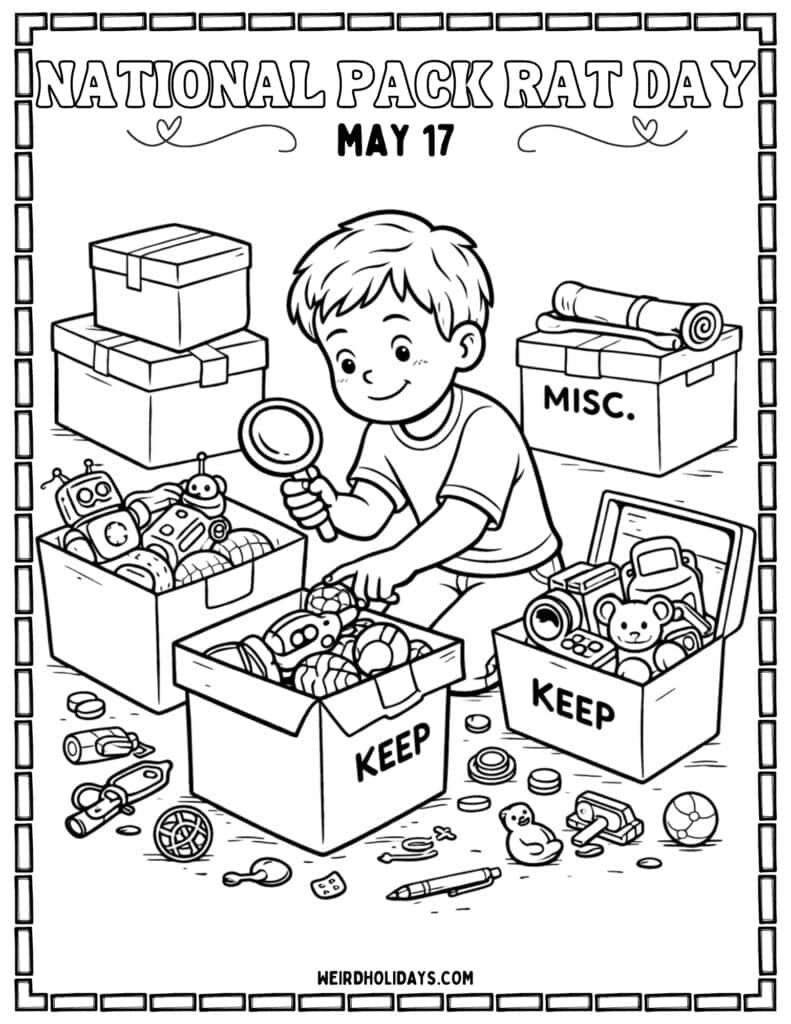
Coloring Page
Print the coloring sheet for younger kids who want to join in on the day. It also works as a quiet activity while you’re sorting through a box of things you’ve been meaning to go through for months.
Activities to Celebrate
The most fitting way to spend today is doing a proper dig through somewhere you’ve been avoiding. A closet, a drawer, a box in the garage. Not necessarily to throw things away, just to actually look at what’s in there. Most pack rats have genuinely forgotten what they have and rediscovering something with a good memory attached to it is one of the better parts of this day.
If you find things worth keeping but not worth displaying, a memory box is a good solution. Pull together the meaningful odds and ends, give them a dedicated home, and stop letting them drift around the house getting lost. It takes about an hour and makes the keeping feel intentional rather than accidental.
A collection swap with friends is worth organizing if you have people in your life who collect things. Vintage books, trinkets, old toys, whatever the group tends to accumulate. One person’s excess is often exactly what someone else was looking for and it keeps things circulating without anything going to waste.
If the physical stuff feels overwhelming, digital cataloging is a reasonable middle ground. Photograph what you have, document it, and give it context. It makes a collection feel curated rather than cluttered and takes up no additional physical space.

**This post may contain affiliate links. As an Amazon Associate and a participant in other affiliate programs, I earn a commission on qualifying purchases.**
Links to Resources
The Psychology of Stuff and Things – a research-based look at why we attach meaning to objects and what that attachment tells us about identity and memory. Worth reading if you’ve ever tried to explain to someone why you still have your childhood eraser collection.
“The Gentle Art of Swedish Death Cleaning” by Margareta Magnusson – a compassionate and often funny guide to letting go of possessions. Less grim than the title suggests and genuinely useful for anyone sitting on decades of accumulated stuff.
Craftsy: Creative Organization Tips – storage ideas and upcycling projects for people who want to keep their materials but actually be able to find them.

Related Holidays
National Clean Off Your Desk Day (January 10) – the more disciplined counterpart to today. A good reset if Pack Rat Day tips you toward action.
National Clean Out Your Computer Day (Second Monday in February) – the digital version of the same impulse. Worth doing alongside a physical sort.
Organize Your Home Day (January 14) – tackles the closets and cabinets rather than the surfaces. A logical next step if today starts something.
Pin it!
Share this post about National Pack Rat Day on Pinterest!
